 EN
EN
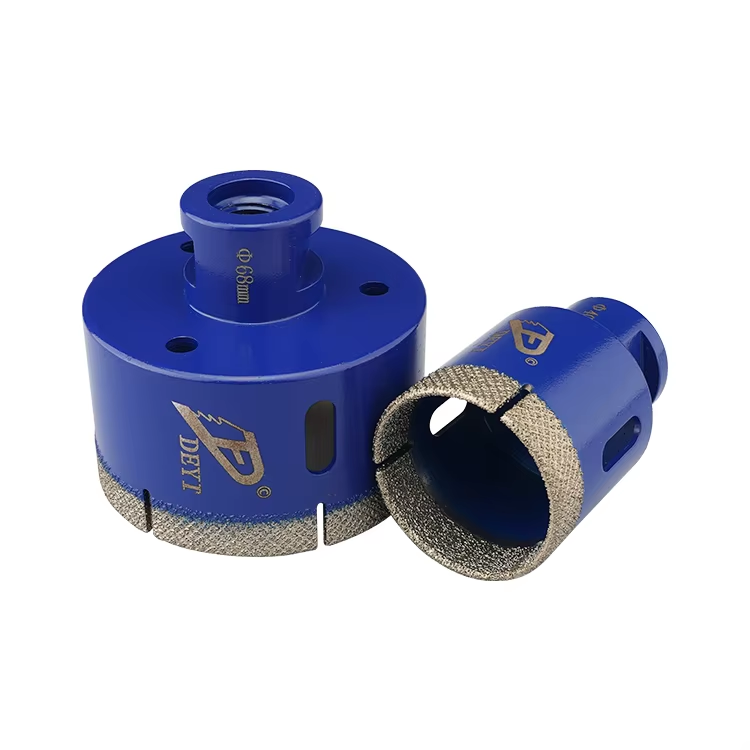
Understanding Adhesion Challenges in Diamond Drill Bits for Glass
Why Smooth Steel Cores Resist Diamond Adhesion
Steel surfaces that have been polished present real problems when it comes to getting diamonds to stick properly. The reason? These surfaces are super smooth, usually under 0.4 microns Ra roughness, which means there's not much grip for mechanical interlocking. Tribology research on abrasive tools shows this smoothness cuts down the actual contact area between diamond and steel by about 70% compared to rougher surfaces. When drilling through glass specifically, where sideways forces can get above 25 Newtons per square millimeter, steel cores that haven't been treated tend to lose their diamonds way too soon. This leads to shorter lasting tools and poor performance overall.
The Role of Surface Energy and Wettability in Bonding
The surface energy level plays a really important role when trying to get good bonding between diamonds and metal surfaces, typically measured in dynes per centimeter. Steel cores that haven't been treated usually have surface energies around 35 dynes/cm or lower, which falls short of the 55 dynes/cm mark required for proper wetting of metal bonding materials. When this happens, we end up with weak spots at the interface where the materials meet, resulting in poor adhesion overall. By using plasma activation as a pretreatment method, manufacturers can boost surface energy up to about 68 dynes/cm. Tests following ASTM D4541 standards show this process improves matrix adhesion by roughly 40%. For companies producing high performance drill bits, this kind of treatment has become an essential part of their manufacturing workflow.
Adhesion Failure in Low-Cost Glass Drilling Bits: A Real-World Case
Looking at 120 different glass drilling operations, researchers noticed something interesting about budget diamond bits versus the premium ones. The cheaper options tended to break down about three times quicker during testing. When it came to actual performance, those low cost bits without special treatment would lose all their diamond particles after just around 15 meters of drilling work. Meanwhile, the better quality bits kept most of their diamonds intact, holding onto about 85% even after extended use. Thermal images taken during these tests showed some serious heat buildup at the spots where failures occurred. Temperatures there hit around 480 degrees Celsius, which is way over what standard bonding materials can handle safely. This suggests that when manufacturers don't properly bond the diamonds to the bit surfaces, the material breaks down much faster under intense heat conditions.
Nickel Plating: Enhancing Surface Activation and Diamond Retention
Nickel plating transforms smooth steel cores into high-performance substrates by increasing surface roughness from 0.8 µm to 3.2 µm Ra, enabling mechanical interlocking of diamond particles. This process directly addresses the adhesion failures seen in low-cost glass drilling tools, significantly improving durability and grit retention.
Pretreatment Processes for Electroplated Glass Drill Bits
Effective nickel plating begins with thorough substrate preparation. Blasting, alkaline degreasing, and acid etching remove oxidation and contaminants that compromise adhesion. Electrochemical activation further enhances bonding by creating micro-pores, improving nickel layer anchoring by 22% compared to untreated surfaces.
Electroless vs. Electrolytic Nickel Plating: Performance and Application
Electroless nickel-phosphorus (Ni-P) coatings offer uniform 8–12 µm thickness even on complex geometries, ideal for precision tools. Electrolytic plating provides faster deposition for high-volume production. Under 300 rpm glass drilling loads, electroless coatings retain 92% of diamond grit, outperforming electrolytic layers, which maintain 84%.
Dual-Layer Ni-P Coating: Achieving 40% Higher Bond Strength
A hybrid approach combining a 5 µm electroless base layer with a 7 µm electrolytic top layer reduces interfacial stress by 18 MPa. This dual-layer system increases diamond grip strength from 28 N/mm² to 39 N/mm² in tempered glass applications, delivering superior bond integrity.
Nano-Enhanced Nickel Composites for High-Stress Glass Drilling
Incorporating 2% silicon carbide nanoparticles into Ni-P matrices increases coating hardness from 600 HV to 850 HV. Field tests show these composites extend bit lifespan by 50% when drilling laminated safety glass under 15 psi feed pressure, making them ideal for high-stress applications.
Laser Texturing: Creating Microstructures for Mechanical Interlock
Optimizing laser parameters for micro-pitting steel substrates
Laser texturing enhances adhesion by creating controlled micro-craters 5–20 μm deep. Precise control of power density (500–1,000 W/cm²), scanning speed (50–200 mm/s), and pulse duration (10–100 ns) ensures optimal pit formation without inducing thermal warping. Modern galvo-mirror systems achieve 95% pattern consistency across curved bit surfaces, enabling scalable, high-precision surface modification.
How microstructures enhance anchoring of diamond grit
Laser-generated micro-pits improve diamond retention through three key mechanisms:
- Lateral confinement: 15–25 μm diameter cavities restrict grit rotation under side-loading
- Vertical support: Undercut geometries form inverse pyramids that resist pull-out forces
- Stress distribution: Randomized patterns reduce crack propagation by 60% compared to uniform grids
These structural features allow drill bits to retain 85% of their initial diamond grit after drilling 200 linear feet of tempered glass.
Case study: 35% longer bit lifespan with pulsed laser texturing
A leading manufacturer replaced chemical etching with fiber laser treatment (1064 nm wavelength, 30% overlap) for its 3–10 mm glass drill bit line. The process created 18 μm deep crosshatch patterns with 12° wall angles, resulting in:
- 35% less diamond loss after 50+ bore cycles
- 22% fewer glass edge chipping incidents
- 17% faster drilling speeds due to improved coolant flow
These results establish laser texturing as a scalable, high-precision alternative to traditional methods like nickel plating, especially for small-diameter tools.
Chemical Functionalization and Antislip Coatings for Stronger Bonding
Silane Coupling Agents: Improving Adhesion on Smooth Steel Cores
Silane coupling agents form covalent bonds between diamond grit and steel cores, enabling adhesion that withstands drilling temperatures up to 150°C. Applied via dip or spray coating, these organosilicon compounds convert low-energy steel surfaces (30–40 mN/m) into reactive substrates, increasing diamond retention by 25% compared to untreated cores.
Polymer-Ceramic Hybrid Coatings for Diamond Grit Anchoring
Epoxy-alumina composite coatings combine polymer flexibility (500–800 MPa tensile strength) with ceramic hardness (15–20 GPa), creating textured anchor points that reduce diamond dislodgement by 38% during tempered glass drilling compared to single-material coatings.
Graded Interlayers: Reducing Thermal Mismatch and Interfacial Stress
Nickel-chromium graded interlayers with gradually shifting thermal expansion coefficients minimize heat-induced delamination. This design effectively dissipates stress at the diamond/steel interface, enabling survival through 3,000+ thermal cycles in demanding automotive glass production environments.
Frequently Asked Questions
How does surface roughness affect diamond adhesion on drill bits?
Smooth steel cores with low surface roughness levels fail to provide adequate grip or mechanical interlocking for diamond particles. By increasing surface roughness, materials enhance their ability to hold onto diamonds, thereby improving tool durability and performance.
What role does surface energy play in diamond bonding?
Surface energy is crucial for effective diamond bonding, as it determines the wettability of metal bonding materials. Untreated steel cores typically have low surface energy, leading to weak adhesive spots. Increasing surface energy can significantly improve diamond retention.
What is the advantage of nickel plating in diamond drill bits?
Nickel plating enhances surface roughness and provides mechanical interlocking for diamond particles, addressing adhesion failures in low-cost drilling tools and significantly improving durability and grit retention.
How does laser texturing improve diamond grit retention?
Laser texturing creates micro-pits that enhance diamond grit retention through lateral confinement, vertical support, and stress distribution, enabling drill bits to retain more diamond grit over extended use.