
 EN
EN
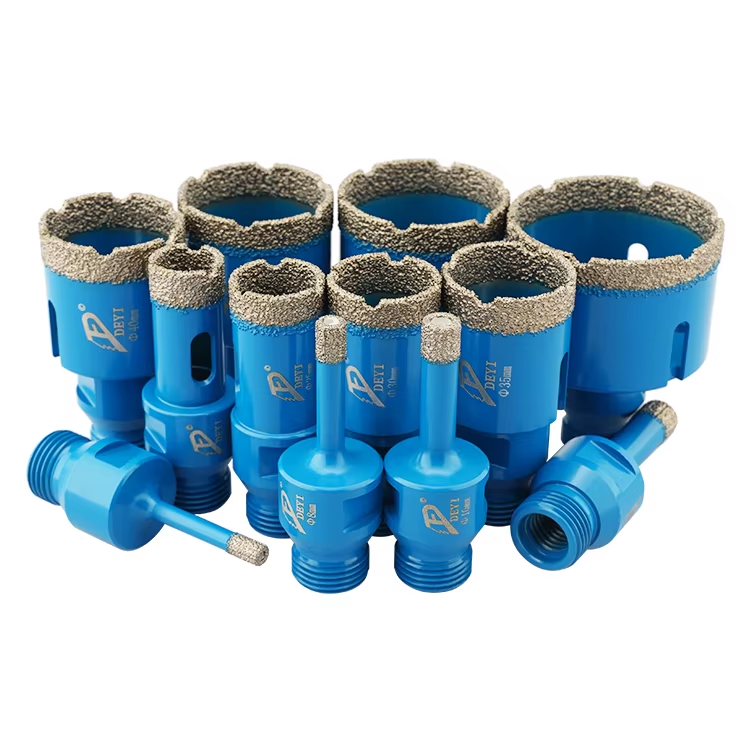
Nondestructive Testing of Brazing Joint Integrity
Nondestructive testing (NDT) methods evaluate diamond core drill bit joints without compromising structural integrity—ensuring brazing quality checks prevent premature failures. These protocols validate joint reliability before tools enter high-stress drilling environments.
Ultrasonic and radiographic inspection for voids and porosity
Ultrasonic testing works by sending those high frequency sound waves right through the brazed joints. When there are hidden voids or other problems in the joint, the sound waves bounce back in specific patterns that tell us something's wrong. Then we have industrial radiography which basically uses X-rays or gamma rays to take pictures inside diamond segments. These images show all sorts of issues like tiny pockets of air (porosity) or when the filler metal isn't spread evenly throughout the segment something our eyes just can't see. Put them together and these methods can spot flaws bigger than half a millimeter deep under the surface. And believe me, finding those small defects before they become big problems is absolutely critical because if left unchecked, such flaws might cause entire diamond segments to come loose while the machine is actually running.
Leak testing and microstructure analysis of brazed interfaces
When we want to check if there's any leakage in the brazed area, pressure decay testing comes into play. Special fixtures help isolate the brazing zone while measuring how much pressure drops over time. This method can spot those tiny leak paths between diamonds and metal surfaces, which is really important for drill bits that need to maintain tight seals when working underwater. Looking at the microstructure gives us another angle on things. We polish and etch cross sections then look at them under magnification ranging from 200 to 1000 times. What shows up includes how far the filler metal has spread, whether carbides have started dissolving, strange grain structures forming, and those pesky brittle compounds that develop between metals. All these signs tell us if the material might crack under heat stress once it goes into actual service conditions.
Visual and Dimensional Inspection for Post-Brazing Defects
Visual inspection serves as the frontline defense in brazing quality checks for diamond core drill bits. Technicians examine each joint under magnification to identify critical flaws:
- Cracks from thermal stress, which compromise structural integrity
- Solder failures, such as insufficient filler metal penetration, risking segment detachment
- Segment misalignment beyond 0.5 mm tolerance—reducing drilling efficiency and shortening bit lifespan
Assessing concentricity, shank deformation, and tube-collet integrity
Getting accurate measurements is critical when working with coordinate measuring machines (CMMs) and laser alignment equipment to check dimensions. When concentricity goes beyond 0.05 mm, we start seeing dangerous wobbling problems during normal operation speeds. Deformed shanks are usually a sign something's wrong with how parts were cooled down after manufacturing. And if there's more than 0.1 mm gap between tubes and collets, coolant can leak in which leads to faster corrosion over time. All these specific tolerance requirements mean drill bits can handle spin rates above 500 RPM without breaking down. Most shops find these specs make all the difference between reliable tools and constant replacements.
Mechanical and Thermal Testing for Brazed Joint Reliability
To ensure diamond core drill bits withstand real-world operational stresses, manufacturers conduct rigorous mechanical and thermal evaluations—validating joint durability beyond visual and dimensional inspection.
Load testing under simulated drilling conditions
Bits undergo axial and rotational loading that replicates concrete and rock drilling scenarios. Progressive loading identifies failure thresholds—such as shear loads between 15–25 kN—while high-cycle fatigue (HCF) testing assesses crack propagation risk after 50,000+ cycles. Additional impact vibration tests confirm segment retention under accelerations exceeding 10g.
Thermal cycling to evaluate performance in high-heat operations
Brazed joints go through temperature fluctuations between 200 and 500 degrees Celsius every five minutes. After experiencing over 100 thermal shocks, engineers look at how the material structure changes. They measure leftover stresses using digital image correlation techniques to spot any warping issues. Coolant compatibility tests also happen to make sure these joints stay stable when drilling operations involve water. These testing procedures tackle problems caused by different expansion rates and stress points in specific areas. When joints pass both mechanical strength tests and thermal shock evaluations, they show failure rates below 0.1 percent according to real world performance data collected from actual applications.
Comparison of Brazing with Alternative Diamond Segment Attachment Methods
Brazed vs. sintered joints in wet and dry core drill bit applications
When it comes to wet conditions, brazed joints really shine because they use those special corrosion resistant filler metals. After going through about 200 wet cycles according to some abrasion tests, these joints still hold together at around 92% of their original strength. Now looking at sintered options, they can handle hotter temperatures when things are dry, like up to 600 degrees Celsius compared to just 550 for brazing. But there's a catch. Tests on concrete drilling show that segments made this way tend to come loose about 15% more often than brazed ones. So if someone needs something that works well in damp environments, brazing gives better value over time even though it might not last as long in extreme heat. On the flip side, sintering makes sense for quick cutting jobs where the material stays dry, although it does cost more upfront.
Laser welding vs. brazing: bond strength and long-term durability
When it comes to bonding strength, laser welding creates connections that are around 40% stronger right from the start compared to high quality brazed joints according to ISO 15614 standards. This process actually fuses metals at a molecular level rather than relying on filler materials which can fail over time. But here's the catch: when we put these joints through accelerated aging tests simulating real world conditions, something interesting happens. Brazed joints keep performing reliably even after going through 10,000 thermal cycles. Laser welded ones begin showing signs of weakness much sooner, losing about 12% of their original strength by the time they reach 7,500 cycles. For long lasting infrastructure work where components need to last decades, this means brazing remains the go to technique despite needing more regular quality inspections throughout the manufacturing process.
| Property | Brazing | Laser Welding | Sintering |
|---|---|---|---|
| Max Temp Resistance | 550°C | 700°C | 600°C |
| Wet Application | Excellent | Good | Poor |
| Service Life | 8,000 cycles | 6,500 cycles | 7,200 cycles |
| Cost Factor | 1.0x | 1.8x | 1.5x |
FAQ
Why is nondestructive testing important for brazed joints?
Nondestructive testing is crucial because it allows the evaluation of diamond core drill bit joints without damaging them. This ensures the integrity and reliability of the joints before they are exposed to high-stress drilling environments.
How does ultrasonic testing detect flaws in brazed joints?
Ultrasonic testing uses high-frequency sound waves to penetrate the brazed joints. Any hidden voids or defects will reflect these waves in specific patterns, signaling problems within the joint.
What is the benefit of using brazed joints over sintered joints in wet environments?
Brazed joints use corrosion-resistant filler metals, making them highly effective in wet conditions. They maintain about 92% of their original strength even after extensive wet cycles.
How does laser welding compare to brazing in terms of bond strength?
Laser welding creates bonds that are initially 40% stronger compared to brazing. However, over time, brazed joints tend to maintain their performance better, especially under long-term stress and thermal cycling conditions.