
 EN
EN
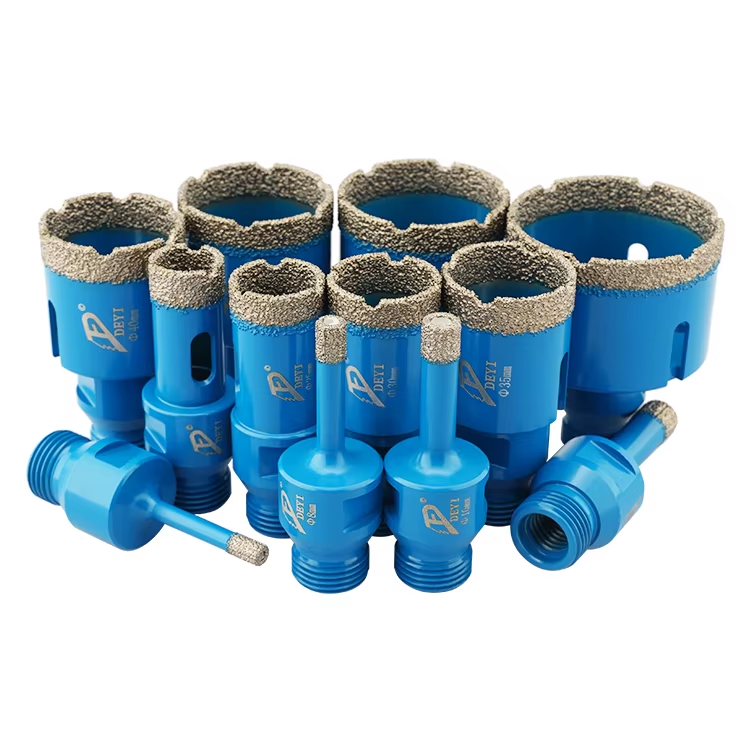
The Science of Diamond Quality in Engineered Quartz Drilling
Defining Diamond Quality: Hardness, Toughness, and Crystal Structure for Quartz Applications
When it comes to drill bits, diamond quality depends on three main factors working together: how hard the material is against deformation, its ability to resist breaking when stressed, and whether the crystal structure is consistent throughout. For engineered quartz that contains around 93% silica and has a Mohs hardness rating of 7, the diamonds used need to be really tough stuff. They should have at least 10,000 HV on the Vickers scale and withstand compression forces over 18 GPa just to keep those cutting edges sharp during operation. What happens with cheaper diamonds? Their irregular crystal structures tend to develop tiny cracks when subjected to the regular back-and-forth forces between 20 and 40 kN that occur while drilling through quartz. These microfractures build up over time, which means the tools wear out faster and don't last nearly as long as they could with better quality diamonds.
Why Synthetic Diamond Grade Matters in High-Silica Engineered Stone Drilling
When it comes to quartz work, synthetic diamonds beat natural ones hands down, lasting about 30% longer thanks to their carefully controlled tetrahedral crystal growth patterns. Manufacturers have tested these High Pressure High Temperature (HPHT) diamonds and found something interesting. Those with under 5% inclusions kept cutting efficiently through over 1,200 holes in materials similar to Caesarstone, whereas regular grade diamonds typically give up the ghost around the 800 hole mark. What makes this possible? The uniform grain boundaries in these synthetic stones help them stick around longer in those tricky high resin areas. And let's not forget, temperatures there can actually reach as high as 600 degrees Celsius while working, which would melt most other options pretty quickly.
How Low-Quality Diamonds Lead to Glazing, Pullout, and Reduced Cutting Efficiency
Substandard diamonds–those with internal flaws or inconsistent sizing–cause two primary failure modes:
- Thermal glazing: Poor heat dissipation, common in diamonds with less than 95% purity, forms a glass-like patina on cutting edges, increasing friction by 40%.
- Matrix bond failure: Irregular diamond surfaces compromise the nickel-cobalt bond, resulting in 15–20% pullout rates when drilling granite-hard quartz.
A 2023 field study across 2,500 quartz countertop installations found that drill bits using ASI-500 certified diamonds exhibited a wear rate of just 0.023 mm per hole, while uncertified grades degraded 3.2 times faster. This accelerated wear directly impacts costs–each additional 0.1 mm of premature wear adds $18.50 in per-bit expenses.
Matching Diamond Quality to Engineered Quartz Hardness and Composition
Engineered quartz–composed of 90–95% crushed quartz bound by 5–10% polymer resins–presents unique drilling challenges. Its combination of high hardness (7–7.5 Mohs) and elastic resin demands precisely matched diamond quality and matrix design to ensure efficient, clean cutting.
Understanding Engineered Quartz Material Properties and Drilling Challenges
Silica content is pretty high here, so we need diamonds that can stand up to heat without their edges wearing down too fast. The resin matrix on the other hand isn't as hard, which changes how the diamond actually works against whatever it's bonded to. When drilling through these materials, there's this tricky balance between getting enough bite to cut through those quartz particles and still having some give to deal with how the resin bounces back after being pressed. That's why fracture toughness matters so much for diamond quality in this context. A diamond that cracks easily just won't last long enough to get the job done properly.
Aligning Diamond Matrix Composition with Substrate Variability
Bond hardness must be tailored to the specific quartz formulation. Cobalt-based bonds perform best in high-silica (>93%) compositions by maintaining strong diamond retention under intense friction. Iron-based matrices are better suited for lower-silica, higher-resin blends. Mismatched bonds increase edge chipping by 18–22% in resin-rich substrates, as shown in recent materials research.
Case Study: Penetration Rate Decline with Substandard Diamonds on High-Resin Quartz
In early 2023, researchers put two different 10mm diamond core bits through their paces on concrete slabs containing roughly 80 percent silica mixed with 20 percent resin binder. The high quality bit equipped with 100/120 US mesh diamonds managed to maintain around 320 revolutions per minute across an impressive total of 38 consecutive holes drilled. On the other hand, when testing the cheaper alternative featuring unevenly sized 80/100 mesh diamonds, things didn't go so well. After only completing 12 holes, this budget option's speed plummeted down to about 210 RPM because so many diamonds were literally pulling out from the matrix during operation. Looking closer at what happened after drilling was finished, it became clear why there was such a big difference. Tests showed those budget diamonds actually had nearly half (about 40%) less transverse strength than required, which caused rapid wear on the surrounding metal matrix material and ultimately resulted in much worse overall performance as time went on.
This demonstrates that both diamond quality and bond compatibility are essential. Subpar grades degrade exponentially in precision applications, significantly increasing operational costs.
Diamond Matrix Design: Bonding, Concentration, and Efficiency Trade-offs
Bond Hardness and Its Interaction with Diamond Quality in Sustained Drilling
The bond matrix acts as the main connection point between diamond grit particles and the underlying material. Getting the right hardness level matters a lot because it affects how well diamonds stay attached versus wearing away at the proper rate. A recent industry study from 2024 found that if there's just a 10% difference either way in bond hardness, cutting performance drops around 38% when working with high silica quartz materials. Too soft of a bond means diamonds fall out prematurely during operation. On the flip side, bonds that are too rigid tend to create what's called glazing effect, basically when heat builds up enough that the diamond crystals stop cutting effectively. Finding this sweet spot becomes absolutely critical when dealing with quartz containing lots of resin. The bonding material needs to wear down gradually alongside the diamonds so new sharp edges keep getting exposed throughout the cutting process.
Coating and Bonding Technologies That Enhance Diamond Retention and Cutting Speed
The latest advances in electroplating techniques combined with vacuum brazing methods give manufacturers control down to the micron level when it comes to diamond protrusion. This has been shown to boost initial cutting speeds anywhere from 15% to 22% better than what we see with traditional single phase bonds, according to tests run on Bretonstone type slabs in lab conditions. When looking at multi layer bonding systems that alternate between hard and soft metal alloys, these actually hold synthetic diamonds in place much better. The result? Tools last longer and stay stable even when pushed beyond standard limits, maintaining performance at those high operational speeds around 3500 RPM and sometimes even higher without losing effectiveness.
The Paradox of High Diamond Concentration with Low-Grade Crystals Reducing Tool Life
When drill bits are packed with over 40 carats of cheap synthetic diamonds per segment, they actually perform worse than models containing just 25 carats of top quality crystals. Quartz fabricators who've tested this have noticed something interesting the tools with all those budget diamonds tend to wear down about 62 percent quicker. Why? The diamond edges crack easily, which leads to tiny fractures throughout the material, creates uneven pressure points, and causes the diamonds themselves to shift around when exposed to heat cycles. The whole "more is better" mindset backfires here, resulting in roughly 23% more frequent replacements for CNC machines running constantly. These extra swaps translate into real money losses for shops doing large scale production runs.
Measuring the Impact of Diamond Quality on Drilling Performance
Key Metrics: Holes-Per-Bit, RPM Retention, and Wear Rate Analysis
When it comes to drilling through engineered quartz, premium synthetic diamonds really stand out from the crowd. According to a recent 2023 study on abrasive machining techniques, these top quality diamonds maintain around 92% of their original RPM during continuous 25mm hole drilling operations, whereas cheaper alternatives drop down to about 68%. Looking at wear rates tells another story entirely. Premium diamond segments typically show minimal wear loss of approximately 0.03mm after making 100 holes, while economy grade bits tend to wear away roughly four times faster at 0.12mm per hundred holes. The difference becomes even more apparent when we look at actual field performance. Industrial tests across multiple sites consistently showed that operators could get through an average of 420 holes (give or take 35) before needing to replace premium tools. That's nearly four times longer than what manufacturers see with standard economy bits which usually last only around 115 holes before showing significant wear.
Field Data: Premium vs. Economy Drill Bits Across 500+ Quartz Installations
Production data from quartz fabrication facilities highlights the return on investment from high-quality diamond bits:
| Metric | Premium-Grade Bits | Economy-Grade Bits | Variance |
|---|---|---|---|
| Avg. Holes/Bit | 387 | 94 | +312% |
| RPM Drop per 50 Holes | 7% | 29% | -22% |
| Replacement Labor Costs | $18.50/hole | $41.20/hole | -55% |
Operators using high-concentration MBS-76 synthetic diamonds reported 63% fewer mid-shift bit changes, significantly reducing downtime in automated workflows.
Variables Affecting Performance in Real-World Production Environments
Four key variables influence drilling efficiency in practice:
- Operator technique variance (±15% wear rate fluctuation, per the 2024 Drilling Dynamics Report)
- Coolant delivery consistency (optimal systems reduce diamond temperatures by 140°C compared to manual methods)
- Batch-to-batch hardness variations in engineered quartz (ranging from 93–107 Vickers across manufacturers)
- Temperature-related matrix expansion (high-grade bonds exhibit 0.009mm/°C thermal stability vs. 0.027mm/°C in standard bonds)
Data confirms that premium diamonds mitigate environmental variability most effectively. Installations using ISO-certified bits maintained less than 5% performance deviation across seasonal temperature shifts, compared to 19–34% variation with unbranded alternatives.
FAQ
Why is synthetic diamond preferred over natural diamond for quartz drilling?
Synthetic diamonds are preferred because they have more uniform crystal structures, which last about 30% longer and provide more efficient cutting, especially in high-resin areas where temperatures can reach 600 degrees Celsius.
What happens when low-quality diamonds are used for drilling quartz?
Low-quality diamonds often have internal flaws or inconsistent sizing, leading to problems like thermal glazing and matrix bond failure, which increase wear and operational costs significantly.
How does diamond concentration impact tool life?
Although higher diamond concentrations might seem beneficial, using too many low-grade diamonds can lead to quicker tool degradation and more frequent replacements, ultimately increasing costs.
Table of Contents
- The Science of Diamond Quality in Engineered Quartz Drilling
- Understanding Engineered Quartz Material Properties and Drilling Challenges
- Aligning Diamond Matrix Composition with Substrate Variability
- Case Study: Penetration Rate Decline with Substandard Diamonds on High-Resin Quartz
- Diamond Matrix Design: Bonding, Concentration, and Efficiency Trade-offs
- Measuring the Impact of Diamond Quality on Drilling Performance