 EN
EN
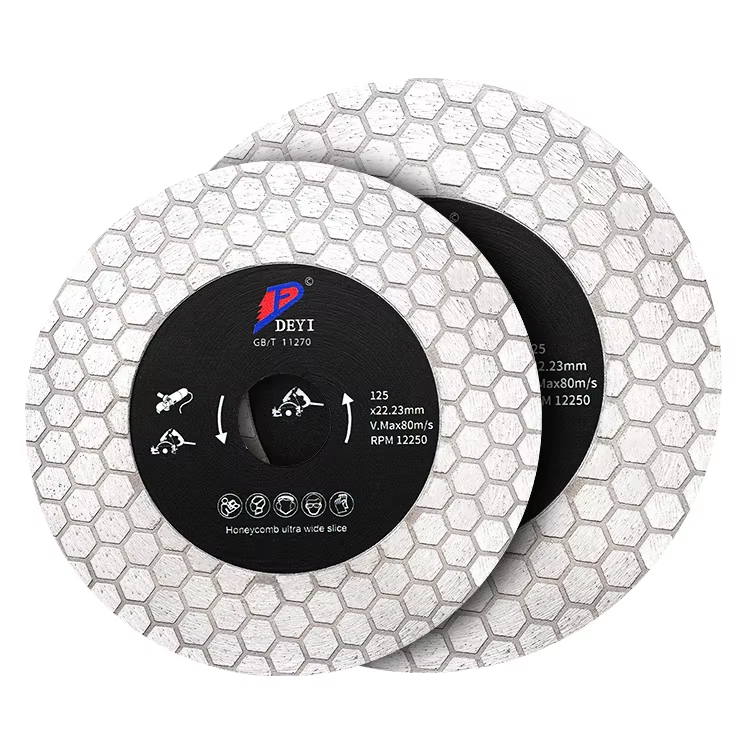
Blade Diameter and Cutting Depth: The Fundamental Mechanical Relationship
When looking at diamond saw blades, their diameter plays a big role in how deep they can cut in one pass. There's actually a geometric reason for this that has to do with the relationship between the blade's radius and how far it can penetrate material. If we want to avoid the blade getting stuck or bound during cutting, then the radius needs to be bigger than what we're trying to cut through. That means bigger blades generally allow for deeper cuts. Take for example standard sizes on the market today: most 14 inch blades will handle around 4.5 inches of material before needing another pass, whereas smaller 10 inch blades typically max out at about 3.5 inches depth. The math behind all this gets wrapped up in something called the depth of cut formula (often labeled as ap in technical documents).
ap = (dw - dm) / 2,
The relationship between the original workpiece diameter (dw) and the final machined diameter (dm) matters quite a bit when selecting cutting tools. Going beyond these limits causes all sorts of problems including poor chip removal, faster wear on blade segments, and even complete blade failure particularly when working with tough stuff like reinforced concrete. That's why big industrial demolition jobs need those massive diameter blades, while smaller tasks such as laying tiles or making edges on countertops typically use compact blades designed specifically for shallow cuts that maintain precision. Getting the right blade size for the job depth isn't just good practice it's essential for keeping workers safe and extending the life of expensive equipment.
RPM, Torque, and Peripheral Speed: How Diameter Dictates Power Delivery
The size of the blade directly affects how fast the cutting edge moves, which we call peripheral speed. This speed is calculated using the formula pi multiplied by diameter times revolutions per minute (RPM). When RPM stays constant, if we double the blade's diameter, the peripheral speed also doubles. This relationship follows a straight line rather than an exponential curve. For instance, a 14 inch blade spinning at 2,000 RPM gives around 7,300 surface feet per minute (SFPM), whereas a smaller 7 inch blade at the same RPM only manages about half that speed at 3,650 SFPM. Safety standards usually cap speeds below 15,000 SFPM for diamond segments, so bigger blades need slower rotations. Larger tools like those over 14 inches typically operate between 1,200 to 2,500 RPM, compared to the faster range of 4,000 to 6,000 RPM for smaller sub 7 inch blades. This difference matters a lot when setting up equipment properly.
As blades get bigger, they need more torque because there's simply more mass to rotate plus greater resistance during cutting operations. For instance, going from an 8 inch to a 12 inch blade means about 30 percent higher torque requirements when working with materials like granite. This is something manufacturers really need to keep in mind when selecting motors and designing drive systems for these applications. If the power isn't sufficient enough, machines will stall out and segments tend to glaze over. On the flip side, running larger blades at too high RPM creates problems too - thermal shock occurs and the bonding material wears away much faster than expected. Getting good results doesn't come down to having maximum horsepower alone. The whole system needs proper balance between revolutions per minute, available torque, and how the blade itself is shaped for best outcomes.
Stability and Vibration Behavior Across Diameter Classes
The size of a blade has a major impact on how it behaves when running. Blades under 14 inches in diameter tend to spin up quickly and handle tight turns well because they don't have much weight behind them. But this same lack of mass means they can't stand up to side-to-side movement or vibrations as effectively, particularly when spinning at higher speeds. As a result, these smaller blades often vibrate more intensely which wears down cutting segments faster and makes for less accurate cuts overall. On the flip side, larger blades over 24 inches work differently. They carry more momentum naturally and dampen vibrations better, but their bigger size creates stronger centrifugal forces. When there's even a small imbalance in such large blades, it leads to those annoying low frequency wobbles that mess with the quality of the cut surface and make operating conditions uncomfortable for workers.
Key contributors to vibration include:
- Peripheral speed: Higher linear velocity at identical RPM increases aerodynamic drag and chatter potential.
- Material engagement: Inconsistent feed or heterogeneous substrates excite resonant frequencies more readily in smaller, less-damped systems.
- Mounting rigidity: Flange design and arbor support must scale with torque and lateral loads—particularly critical for blades over 14 inches.
| Diameter Range | Stability Profile | Vibration Risk Factors |
|---|---|---|
| <14 inches | High maneuverability | Harmonic resonance, lateral deflection |
| 14–24 inches | Balanced performance | Moderate torsional flexing |
| >24 inches | High momentum damping | Low-frequency oscillations, imbalance |
The 2023 research on tool vibrations found something interesting about blade sizes. Blades shorter than 10 inches actually vibrate around 40% more than those in the middle range when running at similar speeds. When picking the right diameter, there are several things to consider together. Workspace limitations matter a lot, along with what the machine can handle and how consistent the material is. Small blades work best for tight spaces where precision counts. But bigger blades need stronger motors, careful balancing, and solid mounts just to keep everything stable during operation. Most shops find this balance point through trial and error rather than strict formulas.
Application-Specific Performance: Matching Blade Diameter to Material and Precision Needs
Small-Diameter Blades for High-Precision, Low-Depth Cuts
Diamond blades measuring less than 4 inches (around 100 mm) aren't built for brute strength but rather for pinpoint precision at tiny scales. The lighter weight means they generate less centrifugal force during operation, which helps create smooth cuts without chips when working with delicate materials like ceramic substrates, printed circuit boards, and carbon fiber components. These smaller blades can adjust their cutting speed quickly enough to handle intricate shapes and patterns. Plus, since they vibrate less compared to larger counterparts, they maintain the structural integrity of what's being cut. Electronics manufacturers regularly use these sub-100mm diamond blades to make kerf widths under 0.3 mm, something absolutely necessary when separating microscopic electronic parts without causing heat-related damage or putting unnecessary strain on sensitive components.
Large-Diameter Blades for High-Volume, Deep-Cut Industrial Applications
When working with materials that require serious cutting power, blades measuring 14 inches or bigger become the go-to choice for jobs where getting deep cuts, moving through material quickly, and maintaining structural integrity matter more than microscopic precision. These big blades have longer cutting arcs that let operators slice right through thick stuff like 12 inch concrete slabs, heavy structural steel beams, or solid blocks of stone in one pass instead of having to make several cuts which saves workers a ton of time on site. The extra weight also helps absorb those sideways kicks from tough aggregate mixes, so the cuts stay consistent throughout. For shops doing steel work specifically, going with blades over 500 mm makes a real difference. They can remove around 30 percent more material each hour compared to smaller blades, plus the segments wear down evenly all the way around the blade edge, which means better performance overall and longer lasting tools before replacement becomes necessary.
FAQ
How does blade diameter affect cutting depth?
The diameter of a blade dictates how deep it can cut in one pass. Larger blades generally allow deeper cuts because their radius is larger, allowing for greater penetration.
What is peripheral speed and how is it affected by blade diameter?
Peripheral speed refers to how fast the cutting edge moves and is calculated by multiplying pi, diameter, and RPM. Doubling the diameter of a blade doubles its peripheral speed, provided RPM remains constant.
Why is torque important for larger blades?
Larger blades require more torque because they have more mass and face higher resistance during cutting. Insufficient power can cause machines to stall and segments to glaze.
How does blade diameter impact vibration?
Smaller blades under 14 inches may vibrate more intensely, while larger blades over 24 inches dampen vibrations better but can suffer from low frequency wobbles if imbalanced.